Views: 222 Author: Linda Publish Time: 2026-06-02 Origin: Site


Content Menu
● Introduction: Why Europe‑oriented seagrass basket suppliers matter
● How we evaluate high‑quality seagrass basket suppliers
>> 1. Factory credentials and management systems
>> 2. R&D and product development capability
>> 3. Quality control (QC) and process capability
>> 4. Delivery reliability and capacity planning
● Seagrass basket technical and compliance know‑how
>> Material grades and construction standards
>> Environmental and safety certifications for Europe
● Transparent selection criteria for this 2026 list
● Top seagrass basket manufacturers and suppliers (Europe‑oriented)
>> 1. HNL CO., LTD. – Flexible design‑driven OEM partner for global brands
>> 2. Guangxi‑based woven basket clusters – Capacity and raw material proximity
>> 3. Shandong water hyacinth and seagrass specialists – Eco‑positioned home decor
>> 4. Multi‑category furniture manufacturers with strong certification portfolios
>> 5. Global importers and consolidators serving European markets
● Key comparison table: capabilities relevant to European buyers
● Industry pain points and how to avoid them
>> Common sourcing pitfalls in seagrass baskets
>> "Insider" avoidance tip rarely written online
● Buyer's guide: Practical steps for sourcing seagrass baskets for Europe
>> 1. Verify the factory and its certifications
>> 2. Sample development and testing workflow
>> 3. Contracting and logistics considerations
>> 4. Ongoing performance management
● FAQ: Advanced sourcing questions from European buyers
Seagrass baskets sit at the intersection of sustainable materials, functional storage, and lifestyle decor, and Europe remains one of the most demanding end markets for this category in terms of product safety, traceability, and ESG expectations. European importers and retailers increasingly require suppliers who can combine traditional weaving skills with modern quality systems, social compliance, and transparent documentation across the entire supply chain. For overseas buyers, this means that partnering with factories already experienced in serving Europe typically shortens onboarding time, reduces compliance risk, and improves the probability of repeatable, long‑term programs. [statista]
Instead of focusing only on geography, this guide looks at manufacturers—primarily in China and Asia—that are structurally aligned with European buyers in terms of materials, certifications, and service models. These suppliers understand EU‑driven requirements around REACH, packaging waste, and sustainable sourcing, and many already support leading European retailers and importers at scale. [andreuworld]
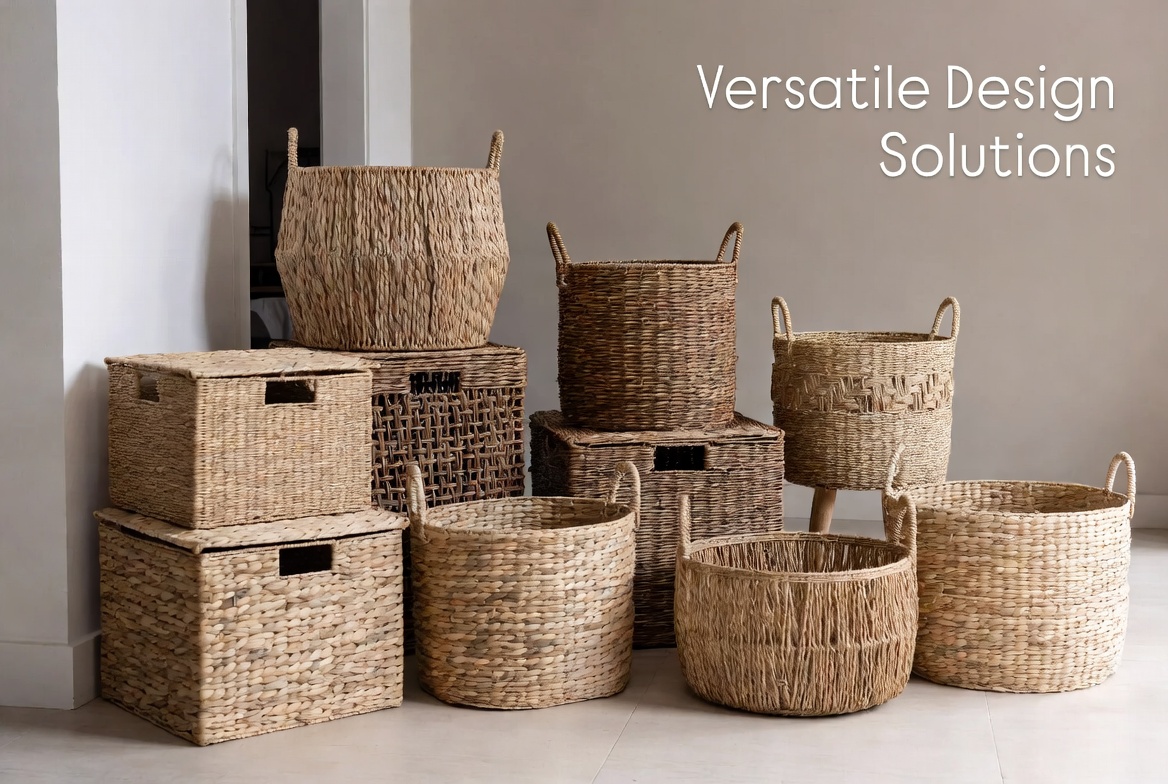
Professional purchasing managers typically start by validating whether a basket supplier runs a documented management system covering quality, environment, and social responsibility. At minimum, you should confirm ISO 9001 (quality management), ISO 14001 (environmental management), and, where relevant, BSCI/SMETA or equivalent social audits, as these frameworks indicate consistent processes rather than one‑off "good batches." In Europe‑facing supply chains, retailers also expect traceability of raw materials and transparent corrective‑action workflows when issues arise. [circulareconomyforfood]
Beyond certificates, look for evidence that the supplier has been classified by authorities or major retailers as a reliable exporter, such as long‑term customs classifications or preferred‑vendor status. HNL CO., LTD., for example, has been certified for many consecutive years as a "Class A Management Enterprise of the People's Republic of China" by Chinese Customs, which signals stable export operations and compliance history. [trademo]
In woven baskets, R&D is less about laboratories and more about design engineering, pattern development, and structural testing under real use conditions. Leading manufacturers maintain in‑house design teams that release hundreds of new SKUs annually, often customizing shapes, handles, linings, and colorways to match specific European retailer briefs and seasonal themes. The ability to quickly prototype and adjust construction (e.g., reinforcing frames, optimizing weave density) is critical for meeting different load‑bearing and performance expectations in the EU versus other regions. [hnlbasket]
When evaluating suppliers, ask to see their annual new‑item pipeline and how they collect feedback from existing European customers to refine designs. A strong OEM/ODM partner can add value not just by copying your reference sample, but by proposing more efficient constructions that reduce material waste or improve packability without compromising appearance. [statista]
For hand‑woven seagrass baskets, natural variation is unavoidable, but leading factories manage this variation with clear QC checkpoints and documented tolerances. Robust suppliers operate incoming material inspection, in‑process checks on weaving and finishing, and final AQL‑based inspections aligned with retailer standards. They also keep reference samples and test reports for each program so that future repeats can be matched consistently. [andreuworld]
From a buyer's perspective, the key is to verify that QC is process‑driven rather than purely visual or subjective. For example, measuring dimensions, weight, load tests, odor checks, and rub‑fastness of dyed components should all be standardized, especially for baskets destined for children's rooms, bathrooms, or kitchens in Europe. [circulareconomyforfood]
European customers expect stable lead times, particularly for seasonal programs linked to back‑to‑school, Christmas, or spring home‑refresh campaigns. The most reliable suppliers plan capacity across peak and off‑peak seasons, maintain flexible workshop networks, and communicate openly about material lead times, especially when seagrass harvesting is weather‑dependent. [trademo]
When vetting manufacturers, buyers should review historical on‑time delivery performance, peak‑season handling, and contingency plans for surges or port congestion. Factories with diversified customer portfolios and long export experience usually manage shipping documentation, palletization, and EU‑specific labeling more smoothly, reducing demurrage and customs delays. [trademo]
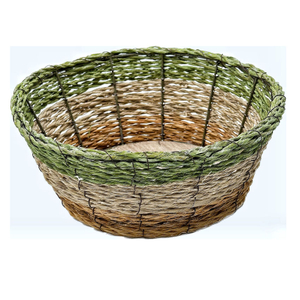
Seagrass used in baskets can vary widely in fiber thickness, twist tightness, moisture content, and pre‑treatment, all of which affect appearance and durability. Better factories source from stable regions and specify drying and storage standards to minimize mold, odor, and color inconsistency, which are major complaint drivers in Europe's humid coastal markets. In multi‑material baskets, seagrass is often combined with metal frames, cotton liners, or plastic imitation rattan, and professional suppliers understand how each component behaves during use and transport. [trademo]
Construction standards typically cover weave density, frame gauge, edge finishing, and handle reinforcement. Suppliers servicing Europe also pay attention to bottom stability (to prevent tipping on hard floors), lint shedding, and splinter‑free finishes, which are increasingly important for indoor storage and children's products. [circulareconomyforfood]
While seagrass baskets are not directly governed by the same regulations as electronics or toys, European buyers often require alignment with broader frameworks such as REACH for chemical safety and, where relevant, FSC for wood components. Many furniture and home brands in Europe also reference ISO 14001 and eco‑design principles similar to those used by companies that have pioneered certified sustainable wood and plastic collections. [andreuworld]
In addition, EU Regulation 2018/848 on organic production and labeling sets a reference point for sustainability claims, even if seagrass baskets themselves are not food products. Buyers should challenge suppliers on any "eco" or "organic" marketing language and request supporting documentation to ensure that claims align with recognized certification bodies such as Ecocert or equivalent. [circulareconomyforfood]
To make this guide truly useful for professional procurement teams, the following criteria were applied when identifying Europe‑oriented seagrass basket manufacturers and suppliers:
- Demonstrated export focus and track record with Europe or global retailers, evidenced by website positioning, case references, or marketplace listings. [trademo]
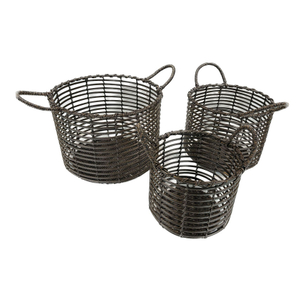
- Core competence in woven natural materials (seagrass, water hyacinth, rattan, bamboo, fern) with optional synthetic complements such as plastic imitation rattan and paper rope. [hnlbasket]
- Documented quality or compliance frameworks (e.g., ISO, long‑term customs classifications, or certifications akin to those used in furniture and home categories). [trademo]
- OEM/ODM service capability, including customization, design support, and sample development workflows aimed at brand and retailer customers. [hnlbasket]
- Suitable scale for long‑term programs, with the flexibility to serve both large chains and medium‑sized brands without excessive MOQs. [trademo]
The companies below are illustrative of the types of suppliers that fit these criteria rather than an exhaustive ranking of every qualified factory in the market.
HNL CO., LTD. was established in 2004 in Nanning, Guangxi, an area known for rich natural material resources and a long tradition of manual weaving. The company specializes in exporting handmade woven products using seagrass, water hyacinth, rattan, fern, bamboo, and complementary artificial materials such as plastic imitation rattan, paper rope, and woven tape. [trademo]
A key strength for European buyers is HNL's experience as a qualified supplier to world‑famous retailers including Wal‑Mart and Tesco, which implies robust QC processes, social compliance practices, and a proven ability to pass demanding retail audits. HNL has been certified for many consecutive years as a "Class A Management Enterprise of the People's Republic of China" by Chinese Customs, indicating strong export compliance and operational stability. [trademo]
From an OEM/ODM perspective, HNL maintains an internal R&D team that develops hundreds of new designs each year across storage and organization, kitchen and bathroom, garden and planter, home decor, store display, gift packing, and pet baskets. This makes the company particularly suitable for small and mid‑sized European brands that need flexible, design‑driven collections rather than generic commodity baskets. HNL's customization service allows buyers to adjust dimensions, colors, materials, and packaging to align with specific retail formats and logistics requirements. [trademo]
Given its balanced positioning between scale and flexibility, HNL is a strong option for European buyers looking for a long‑term partner who can handle both stable core programs and smaller, trend‑driven capsule launches. [hnlbasket]
Guangxi and neighboring provinces host several woven basket manufacturers that draw on nearby mountains and river systems for natural materials such as seagrass, rattan, bamboo, and water hyacinth. One example is a Guangxi factory specializing in storage baskets and boxes that sources materials like grass, bamboo, and water hyacinth, complemented by metal, plastic, and paper rope, reflecting the typical multi‑material mix used in modern seagrass‑blend baskets. [1688]
Factories in this cluster typically operate as OEM producers for international buyers and can scale production via village‑level weaving networks, making them suitable for high‑volume European orders. Buyers should evaluate the individual factory's QC systems, social compliance, and export documentation, as these can vary even within the same region. With proper vetting, Guangxi‑based suppliers offer a combination of cost competitiveness, raw‑material security, and traditional craftsmanship aligned with European market needs. [1688]
In Shandong province, some companies have built a reputation for water hyacinth and seagrass woven products targeted at export home‑decor markets. For example, one Shandong enterprise's eco‑crafted water hyacinth products recently received significant orders at a German home show, reflecting strong European demand for natural, eco‑branded storage and decor solutions. [gongyipin]
These factories typically emphasize environmentally friendly processing and promote their products as part of the broader "green consumption" trend in Europe. For sourcing managers, the key is to match marketing claims with hard data: asking for test reports, certification copies, and clear explanations of how the company controls raw‑material treatment, coloring, and finishing to meet EU expectations on emissions and sustainability. When this documentation is in place, Shandong suppliers can be effective partners for mid‑ to high‑end seagrass and water‑hyacinth collections. [gongyipin]
A number of European and Asia‑based furniture companies have built advanced certification portfolios covering FSC, ISO 9001, ISO 14001, eco‑design, and circular‑economy frameworks, and some of them also source or coordinate seagrass and natural‑fiber baskets as part of broader home‑decor assortments. One such company, for example, has obtained full FSC certification across its wood collections, eco‑design certification under ISO 14006, and environmental management certification under ISO 14001, alongside product‑level labels for indoor air quality and circularity. [andreuworld]
While these firms may not always be the direct weavers, they often serve as program integrators for major European retailers, coordinating seagrass basket production with certified subcontractors and applying the same rigorous environmental and quality frameworks to these SKUs. For buyers who prioritize certification depth and corporate reporting (e.g., for ESG disclosures), collaborating with such integrators can help embed seagrass baskets into broader, sustainability‑aligned home programs. [circulareconomyforfood]
In addition to direct factories, there is a layer of importers and consolidators in Germany and other EU countries that specialize in woven baskets and organize supply from Asian manufacturers. Trade‑intelligence platforms show multiple seagrass‑basket importers in Germany, indicating a mature ecosystem of companies that manage compliance, logistics, and assortment building on behalf of retailers. [trademo]
These firms do not manufacture but can be strategic partners for buyers who require smaller MOQs, mixed‑container assortments, or on‑the‑ground quality control in Europe. When working through consolidators, it is still important to understand the original factories' material and compliance profiles to avoid surprises around product safety or sustainability claims. [andreuworld]
The table below summarizes typical differences among the supplier types discussed, with HNL CO., LTD. as a representative flexible OEM/ODM factory serving global retailers. Values are indicative and intended as a decision‑support tool, not strict rankings.
| Supplier type / Example | Typical annual capacity (40' HQ equivalent) | Typical MOQ per SKU for EU programs | Representative certifications / credentials | OEM/ODM focus and design support | Fit for European buyers |
|---|---|---|---|---|---|
| HNL CO., LTD. (China, Nanning) | Medium–high: stable export volume for global retailers (trademo) | Flexible; often supports lower MOQs for brand programs (trademo) | Long‑term "Class A Management Enterprise" customs status; experience with Wal‑Mart, Tesco audits (trademo) | Strong in OEM/ODM with hundreds of new designs yearly and customization service (trademo) | Ideal for buyers needing high cost‑performance, flexible programs, and deep customization (trademo) |
| Guangxi woven‑basket clusters | High: scalable via local weaving networks (1688) | Medium; MOQs driven by material seasonality (1688) | Factory‑specific; some hold ISO/social audits, needs verification (andreuworld) | Mainly OEM, design capabilities vary by factory (1688) | Suitable for large‑volume, price‑sensitive EU orders with due‑diligence on QC (1688) |
| Shandong water‑hyacinth / seagrass specialists | Medium: focused on eco home‑decor lines (gongyipin) | Medium; often aligned with trade‑fair order patterns (gongyipin) | Emphasis on eco positioning; formal certifications vary by firm (gongyipin) | OEM/ODM with strong story‑telling around sustainability (gongyipin) | Good for eco‑branded collections targeting European lifestyle chains (gongyipin) |
| Certified furniture manufacturers / integrators | Medium–high: multi‑category capacity (andreuworld) | Medium; often require program‑level volume (andreuworld) | ISO 9001, ISO 14001, FSC, eco‑design, circular‑economy labels, indoor‑air certifications (andreuworld) | Strong design and engineering teams, including material and sustainability experts (andreuworld) | Best for ESG‑driven buyers integrating baskets into wider certified assortments (andreuworld) |
| EU‑based importers / consolidators | High: portfolio‑based sourcing from multiple factories (trademo) | Low–medium; can mix SKUs and suppliers in one shipment (trademo) | EU trade compliance; often rely on upstream factory certifications (circulareconomyforfood) | Limited own design; curate and adapt factories’ ranges (trademo) | Ideal for smaller retailers needing consolidated shipments and local service (trademo) |
- Material downgrading and inconsistent fiber quality: Some suppliers quietly switch to lower‑grade seagrass or mix with inferior grasses, leading to color inconsistency, odor, and reduced lifespan, especially after arrival in Europe's cooler, drier climates. [circulareconomyforfood]
- Hidden moisture and mold risk: Inadequate drying and storage before packing can trap moisture, resulting in mold growth during sea transit, a frequent cause of claims in natural‑fiber categories. [circulareconomyforfood]
- Weak frames and handle failures: Under‑specified metal or wooden frames and poorly reinforced handles can fail under load, generating returns and negative reviews for European retailers. [andreuworld]
- Undocumented finishes and chemicals: Lack of traceability for dyes, coatings, or anti‑mold agents creates risk under REACH and retailer chemical‑management policies. [andreuworld]
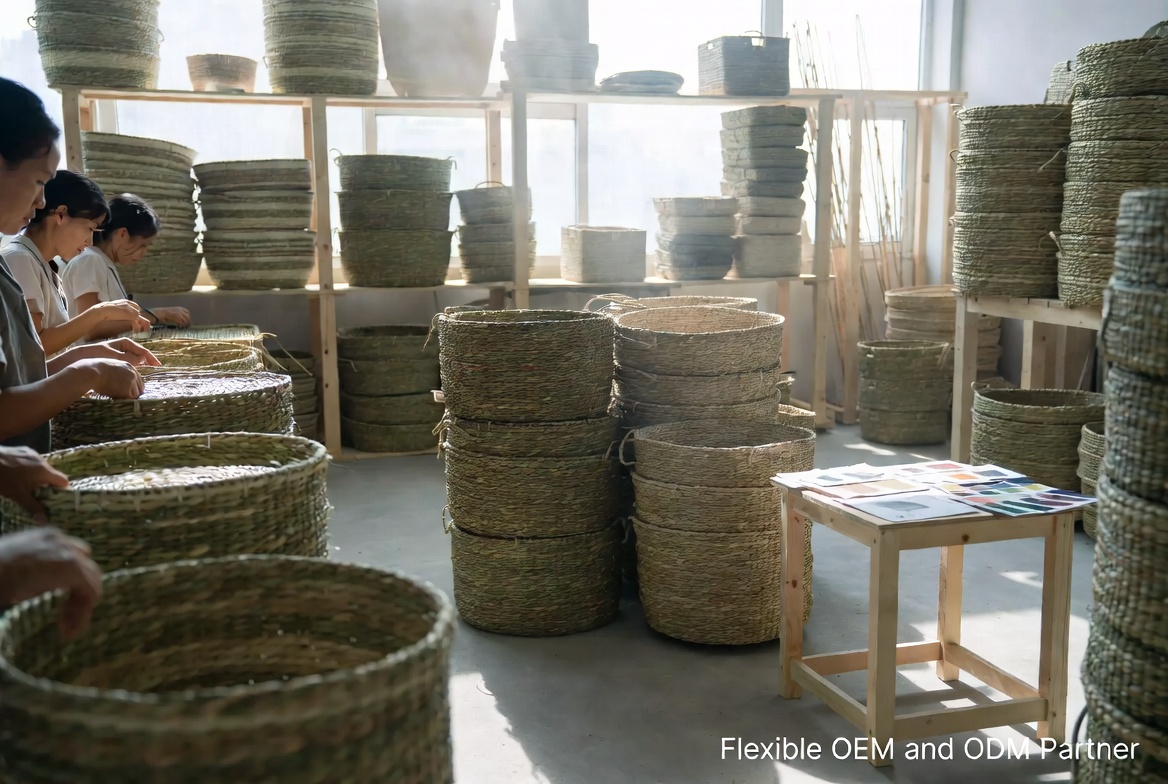
An internal rule used by experienced buyers is to always request photos of the production workshop and raw‑material storage areas taken on different days and angles, not just showroom shots, and to cross‑check them against timestamp metadata and third‑party audit reports. Inconsistent workshop imagery, constantly changing layouts, or reluctance to share real‑time photos can indicate over‑outsourcing, unstable workforce, or the use of temporary subcontractors, which often correlates with quality drift in hand‑woven products. [circulareconomyforfood]
- Request complete copies of ISO 9001, ISO 14001, BSCI/SMETA, and any FSC or eco‑design certificates, along with validity dates and certifying bodies. [andreuworld]
- Cross‑check the certificate numbers on the issuing body's website to confirm authenticity and expiry status; many registrars maintain public databases. [andreuworld]
- For exporters like HNL with customs classifications such as "Class A Management Enterprise," confirm this status via official customs or government portals where possible. [trademo]
- Start with a clear technical specification: target dimensions, load‑bearing expectations, color tolerance, odor requirements, and packaging constraints. [trademo]
- Request at least two to three rounds of samples, including one "PP sample" (pre‑production) that has been produced using the actual workshop, materials, and workers planned for mass production. [andreuworld]
- Conduct independent lab tests where necessary—for example, checking for restricted substances under REACH or verifying color‑fastness for dyed components or liners. [circulareconomyforfood]
- Align Incoterms (FOB, CIF, DAP) with your internal logistics capabilities and EU port preferences, and ensure that packaging, palletization, and labeling meet both customs and retailer requirements. [trademo]
- Build realistic lead times that account for seagrass harvesting and drying seasons, especially when ordering for peak European consumption periods. [gongyipin]
- Consider consolidating shipments across SKUs or suppliers via consolidators or integrators to improve container utilization and reduce average landed cost. [trademo]
- Implement regular vendor scorecards tracking on‑time delivery, claim rates, audit findings, and innovation contributions (e.g., new designs proposed per season). [andreuworld]
- Schedule periodic on‑site or third‑party inspections, especially when volumes ramp up, to detect drift in material quality or workmanship early. [circulareconomyforfood]
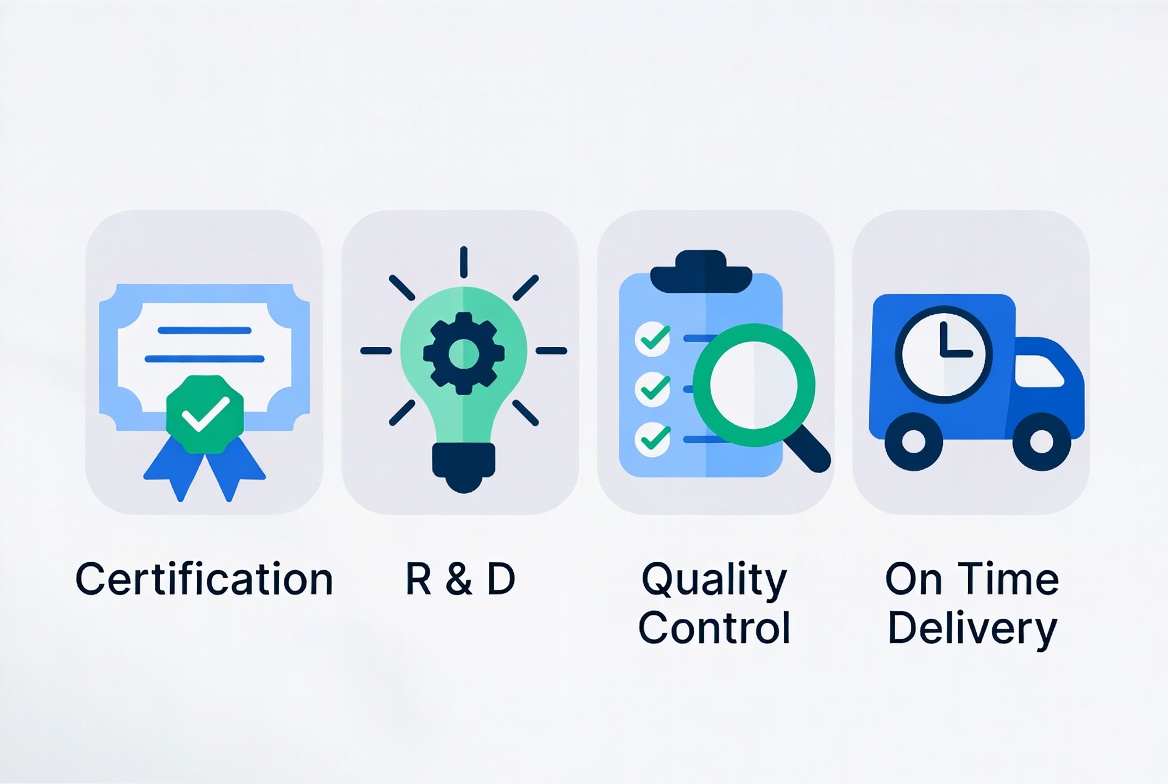
European demand for natural, sustainable storage solutions continues to grow, but the bar for quality, compliance, and transparency is rising just as quickly. Sourcing managers who select seagrass basket suppliers based on structured criteria—factory credentials, R&D depth, QC systems, and delivery reliability—are far better positioned to build long‑term, low‑friction partnerships that can scale with European market demands. [trademo]
HNL CO., LTD. exemplifies a balanced partner profile for Europe‑oriented buyers: strong export track record, a broad material and product portfolio, continuous design development, and flexible OEM/ODM support suitable for both large retailers and emerging brands. If you are planning to launch or optimize a seagrass basket program for Europe in the 2026–2027 seasons, consider shortlisting factories with similar profiles and initiating structured sample and audit processes now. [trademo]
If you share your target sales channels (e.g., Amazon EU, big‑box retailers, or boutique home‑decor stores), I can help you tailor a more specific supplier short list and technical spec template for your needs.
1. How can I verify whether a factory's ISO or social‑audit certificate is still valid and not expired?
Ask for the full certificate copy, not just a photo, and note the certificate number, issue date, and expiry date. Then, visit the certification body's website (e.g., SGS, TÜV, Bureau Veritas) and use their online verification tool or contact channel to confirm current status. Many auditors also publish public summaries of the audit scope and sites covered, which you should compare against the factory's declared locations. [andreuworld]
2. What is a realistic lead time for seagrass basket orders into Europe, and how does seasonality affect it?
Typical lead times range from 45 to 75 days from sample approval to FOB, depending on order size, complexity, and workshop loading. During peak seasons or when seagrass harvesting is disrupted by weather, lead times can extend, so serious buyers align ordering cycles with suppliers' material calendars and secure capacity blocks in advance. [gongyipin]
3. How do I ensure that materials marketed as "eco" or "sustainable" actually meet European expectations?
Request concrete documentation such as FSC certificates for wood, organic or integrated‑production certificates for relevant plants, and clear explanations of chemical and finishing processes. Cross‑check marketing claims against recognized frameworks (e.g., EU Regulation 2018/848 for organics) and, where necessary, run independent testing for restricted substances. [circulareconomyforfood]
4. What is the best way to manage quality variation in hand‑woven seagrass baskets across large European orders?
Define acceptable tolerances for dimensions, color variation, weave irregularities, and other visual attributes in advance, and embed them in both the purchase contract and QC checklists. Use golden samples, detailed photos, and measurable criteria, and conduct AQL‑based inspections on each batch, especially for key accounts. [andreuworld]
5. How can I balance MOQs and assortment breadth when testing new seagrass ranges in Europe?
Work with flexible OEMs like HNL or with EU‑based consolidators that allow mixed SKUs per container and lower per‑SKU MOQs. Start with a focused assortment of "hero" sizes and colors, then expand once sell‑through data confirms demand, using the same supplier to maintain visual consistency and simplify reorders. [trademo]
- HNL CO., LTD. official company profile and capabilities overview. [hnlbasket]
- Statista – general 2026 market and methodology context (access gateway for category‑specific reports). [statista]
- EU sustainability and organic certification guidance and related frameworks for environmentally responsible production. [circulareconomyforfood]
- Multi‑certified European furniture manufacturer sustainability and certification portfolio (ISO 9001, ISO 14001, FSC, eco‑design, circularity). [andreuworld]
- Regional woven‑basket industry and export‑oriented cluster information in Guangxi and Shandong, China, including eco‑positioned water‑hyacinth products. [1688]
- Trade‑intelligence platforms listing global and German seagrass basket importers and buyers. [trademo]