Views: 222 Author: Linda Publish Time: 2026-06-21 Origin: Site


Content Menu
>> Key Material Characteristics of Paper Rope
>> Key Material Characteristics of Seagrass
● Scratch‑Free Performance: Paper Rope vs. Seagrass
>> How Scratches Happen on Leather in Storage
>> Paper Rope: Scratch‑Free Behavior
>> Seagrass: Scratch‑Free Behavior
● Side‑by‑Side Comparison for Leather Storage
● Expert Insight from a Manufacturing Perspective
>> When We Recommend Paper Rope First
>> When We Recommend Seagrass First
● Design Strategies to Reduce Scratch Risk in Real Projects
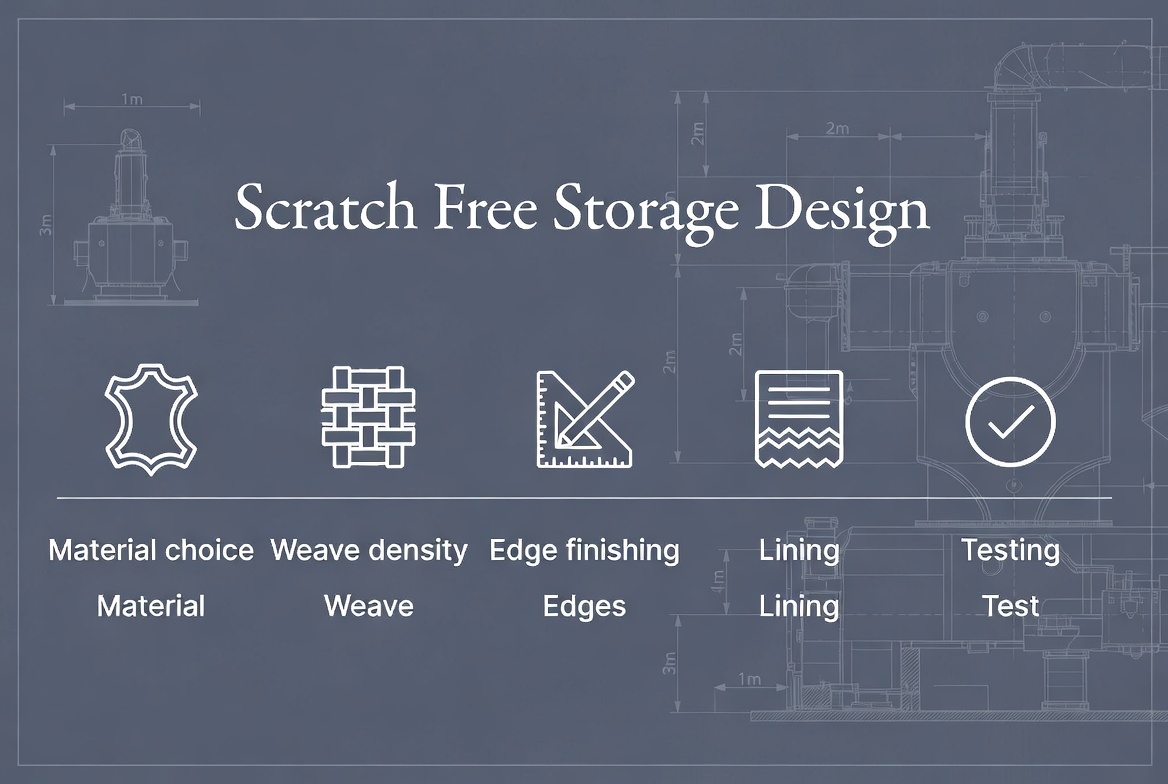
>> 5 Practical Design Principles
>> Simple Testing Protocol for Brands
● Sustainability, Compliance, and Brand Story
>> Paper Rope Sustainability and Compliance
>> Seagrass Sustainability and Compliance
● Cost, Scalability, and Product Line Planning
>> Cost and Scalability Perspective
● How to Choose: A Quick Decision Framework
>> Decision Checklist for Leather Storage Buyers
● How Our Factory Can Support Your Next Project
● FAQs
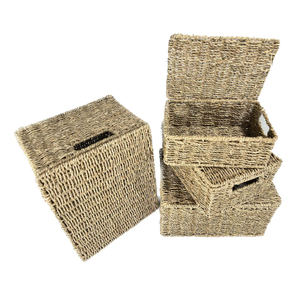
High‑end leather accessories demand storage that is not only beautiful but also truly scratch‑free, stable, and long‑lasting. As a factory with over 20 years of woven‑goods manufacturing experience in natural and synthetic fibers, we see brands repeatedly struggling to choose between paper rope and seagrass baskets, trays, and boxes for premium leather. This article compares both materials from a practical, factory‑floor and brand‑owner perspective, so you can specify the right solution for your next collection. [1688]
Paper rope (sometimes called paper cord or paper wicker) is a twisted or braided strip of processed paper fiber engineered to behave more like a textile than ordinary paper. [iropes]
- Surface feel: Generally smooth, slightly matte, with consistent texture along the rope. [jianghu.taobao]
- Flexibility: Good bending performance; can be woven into tight or open patterns without easy cracking. [jianghu.taobao]
- Weight: Lightweight, making it ideal for portable storage boxes and decorative baskets. [jianghu.taobao]
- Design versatility: Accepts dyes well, allowing controlled color palettes (nudes, deep browns, brand colors). [cnblogs]
From a manufacturing standpoint, high‑grade paper rope is treated to enhance tensile strength and bending resistance, so it holds shape under daily use. This is important for storage that will carry leather bags, wallets, or belts and be frequently opened and closed. [jianghu.taobao]
Seagrass used in weaving is typically a dried, twisted natural marine grass (or similar coastal plants) processed into ropes, cords, or flat braids. [hgbegin]
- Surface feel: Natural, slightly uneven, with visible fibers and a handcrafted aesthetic. [hgbegin]
- Strength: Good tensile strength for baskets and structured boxes; often combined with metal or rattan framing. [chinese.alibaba]
- Natural variation: Color varies from light straw to deeper olive tones as part of its visual appeal. [hgbegin]
- Eco‑perception: Seen by consumers as a very eco‑friendly material due to its natural origin and biodegradability. [cn.globy]
Seagrass is popular for coastal, resort, and organic‑style collections, especially when clients want the "natural luxury" story for lifestyle and home‑storage ranges. [cn.globy]
When the core requirement is scratch‑free storage for delicate leather, the conversation shifts from aesthetics to micro‑level surface interaction with the leather surface.
Leather gets scratched in storage mainly due to:
1. Hard or sharp fibers catching the surface during insertion or removal. [iropes]
2. Seams, metal fasteners, or rough cut edges on the storage container. [patents.google]
3. Dust and particles trapped in the weave, acting as abrasives. [iropes]
For premium leather (full‑grain calfskin, lambskin, or smooth finished leather), even micro‑abrasion can become visible over time.
Well‑finished paper rope typically offers:
- More uniform, smoother yarns with fewer protruding fibers than raw plant stems. [jianghu.taobao]
- Lower friction when sliding leather items in and out, especially if the weave density is high. [jianghu.taobao]
- Less risk of hard nodules, since the material is engineered and more controlled in thickness. [iropes]
In our manufacturing practice, we often recommend paper rope for:
- Storage trays with open tops used daily on counters.
- Small accessory organizers for wallets, belts, and card holders.
- Interior compartments of larger boxes where leather touches the side walls.
If combined with fabric lining or a smooth board bottom, paper‑rope structures can create a highly forgiving environment for leather surfaces. [cnblogs]
Seagrass is naturally more textured and fibrous, which creates a different scratch profile:
- Individual strands may show small, stiff fiber ends, especially on cut edges. [chinese.alibaba]
- Under rubbing, these points can mark very soft leather finishes over time.
- Fine leather can also pick up impressions from a coarse seagrass pattern if stored under pressure.
To keep seagrass storage scratch‑friendly, brands usually:
- Specify tighter, more uniform weaves to minimize protruding fibers. [chinese.alibaba]
- Add inner textile or PU linings on surfaces that touch leather directly.
- Use seagrass more for the outer body of storage pieces, keeping internal contact surfaces in a smoother material.
For unlined seagrass baskets used with premium leather, we typically recommend limiting use to dust‑bag‑protected items rather than bare leather.
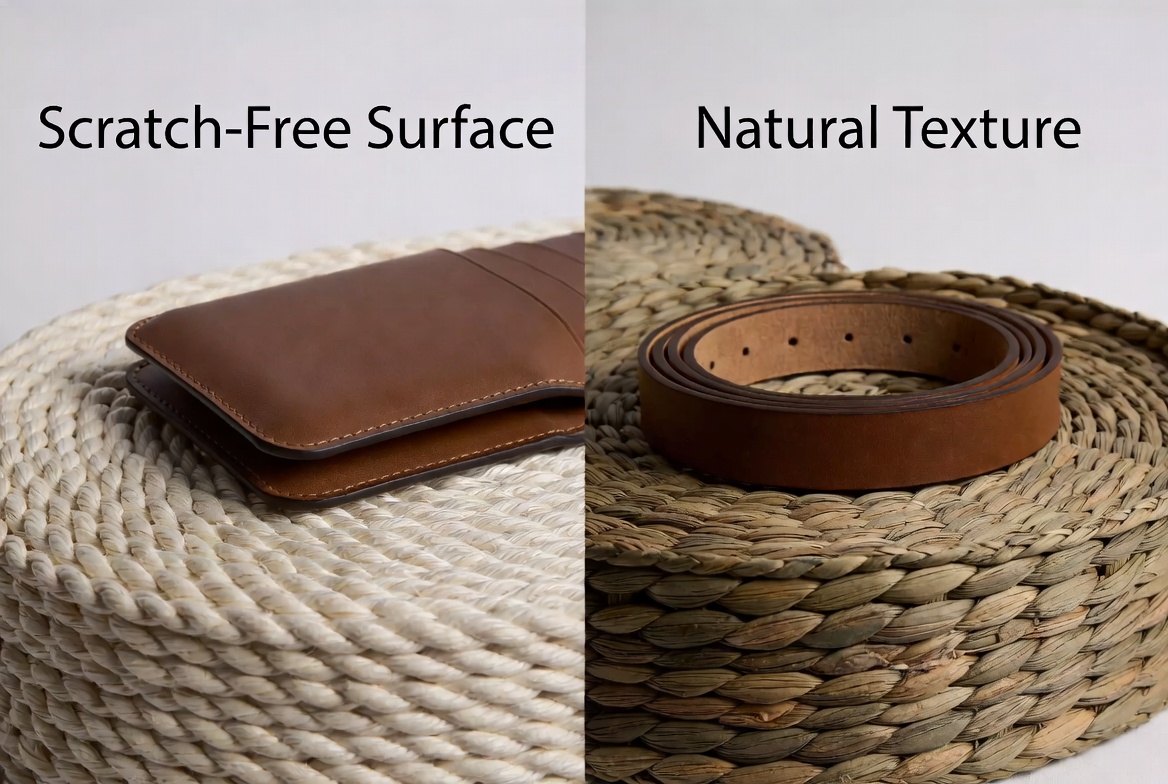
| Factor | Paper Rope Storage | Seagrass Storage |
|-----------------------------|------------------------------------------------------|----------------------------------------------------------|
| Surface smoothness | Generally smoother, uniform fibers [jianghu.taobao] | More textured, natural fiber ends [hgbegin] |
| Scratch risk (bare leather) | Lower with dense weave and good finishing [jianghu.taobao] | Medium; needs careful finishing/lining [hgbegin] |
| Aesthetic style | Clean, modern, controlled colors [cnblogs] | Rustic, coastal, organic look [hgbegin] |
| Color control | Excellent; wide and stable palette [cnblogs] | Limited, natural tones dominate [hgbegin] |
| Structural stability | Good when framed or reinforced [jianghu.taobao] | Very good, especially with frames [chinese.alibaba] |
| Perceived eco‑friendliness | High if recycled fibers used [cnblogs] | Very high; 100% natural plant material [hgbegin] |
| Weight | Light | Light‑to‑medium, depending on gauge [chinese.alibaba] |
| Cost flexibility | Wide range via spec control [cnblogs] | Also flexible, but more tied to raw harvest cycles [hgbegin] |
| Best leather use case | Bare leather, daily access organizers | Dust‑bagged leather, display‑focused storage |
From a factory and OEM/ODM supplier view, the choice between paper rope and seagrass is rarely only about "which is better"; it is about which is better for your specific application and brand story. [1688]
We typically prioritize paper rope for brands that:
- Sell high‑end leather wallets, purses, belts, and watch straps where surfaces must stay pristine.
- Need consistent branding colors across storage and packaging collections. [cnblogs]
- Plan to sell through department stores or boutiques where touch‑and‑feel at shelf level matters.
Because paper rope can be engineered, we can fine‑tune:
- Yarn diameter and twist for softer handfeel.
- Weave density to reduce gaps and snag points.
- Edge finishing (fold‑back or binding tapes) to remove exposed cut ends.
This makes paper rope an excellent primary choice for scratch‑free storage, especially when the interior is not additionally lined.
We lean toward seagrass when clients:
- Want a strongly natural, resort, or coastal identity in their storage line. [cn.globy]
- Plan to use dust bags or inner pouches for the leather pieces.
- Prioritize sustainability storytelling and visible natural grains.
In these projects, seagrass often becomes the outer structure, while internal trays, dividers, or inserts are built with paper rope, fabric, or other softer materials to safeguard the leather.
Regardless of material, smart design can significantly reduce the risk of scratching on premium leather.
1. Control the contact zone
Ensure that the part touching leather (bottom and inner walls) is either smooth paper rope, fabric, or another soft liner. [iropes]
2. Increase weave density
A denser weave reduces small gaps where edges and fibers can catch leather corners. [chinese.alibaba]
3. Round and bind edges
Use rounded rims and bound edges instead of raw cut edges to avoid hard contact points. [shuma.taobao]
4. Add removable inserts
Soft, removable mats or trays create an extra buffer while maintaining the visual impact of the outer structure.
5. Match load to structure
For heavier leather bags, combine woven bodies with metal or rattan frames for shape stability, preventing deformation that can pinch or crease leather. [patents.google]
Before mass production, we recommend a quick scratch‑risk validation:
- Place a sample leather panel in the basket or box.
- Simulate 50–100 insert/withdraw cycles with realistic angles.
- Check under good lighting for micro‑scratches, gloss change, or fiber transfer.
This simple test, combined with factory feedback, often determines whether you should stay with paper rope, further smooth the seagrass, or add a liner.
For high‑end leather brands, sustainability and compliance now sit alongside aesthetics and protection.
- Many manufacturers use recycled paper fibers or certified pulps for paper rope, making it a credible eco option. [cnblogs]
- The material is typically lightweight, which also reduces shipping emissions per unit.
- Paper‑based structures can be designed for easier material separation at end of life.
For export markets, brands often ask for FSC or similar documentation from upstream fiber suppliers to support their ESG storytelling in packaging and storage accessories. [cnblogs]
- Seagrass is a renewable natural resource and biodegradable in principle. [hgbegin]
- It supports a strong natural‑materials narrative that aligns well with vegetable‑tanned or artisanal leather positioning. [cn.globy]
- Stability of appearance and quality depends on harvest and drying conditions, so a reliable supply chain is essential. [hgbegin]
For both materials, brands targeting Japan, EU, or North America often request additional lab tests on colorfastness, odor, and chemical safety, which a mature factory can help coordinate.
Choosing between paper rope and seagrass also shapes cost structure and range planning.
- Paper rope
- More predictable pricing due to industrialized fiber sourcing. [cnblogs]
- Easy to maintain color continuity across production batches.
- Highly scalable for large retail or e‑commerce programs.
- Seagrass
- Cost can fluctuate with seasonal availability and harvest conditions. [chinese.alibaba]
- Color tone and texture may vary slightly by batch, which some brands treat as a feature, not a defect.
- Excellent for limited collections or capsule drops with a handcrafted feel.
A common strategy is to use paper rope for the core evergreen SKUs (e.g., standard leather storage boxes) while launching seagrass‑accented collections as seasonal or storytelling pieces.
Ask these questions before finalizing your material:
- Will leather be stored bare or in dust bags?
- Is your brand narrative more minimalist/modern or natural/coastal?
- Do you need strict color control across seasons and batches?
- Are you planning large‑scale rollouts or smaller, high‑storytelling runs?
- Is scratch‑free performance the first priority, or do you accept minimal patina over time?
If scratch‑free protection and precision branding dominate, paper rope is usually the primary recommendation, potentially combined with soft linings. If storytelling around nature and craft is dominant, seagrass can lead, with scratch protection managed by design and lining choices.
As a woven‑product manufacturer with decades of experience in both natural materials (including seagrass, water hyacinth, rattan, fern, bamboo) and engineered fibers (paper rope, imitation rattan, plastic bands), we support brands from concept to shipment. [1688]
We can help you:
- Select paper rope, seagrass, or hybrid constructions based on your leather range and markets.
- Prototype scratch‑free interiors with tested weaves and linings.
- Align material and structure choices with your sustainability and brand‑story goals.
If you are planning a new high‑end leather storage line, you can share your product list, retail targets, and desired brand style, and we will propose two to three material and construction options with clear pros and cons for scratch performance, cost, and lead time.
If you are preparing your next high‑end leather accessories collection and need scratch‑free, brand‑consistent storage, consider starting with a paper‑rope‑based core line and seagrass accent pieces. Reach out with your target SKUs, preferred price points, and market channels so we can co‑develop a woven storage solution that protects your leather as carefully as you design it.
Q1: Is paper rope safe for very soft lambskin leather?
A1: When produced with smooth fibers and a dense weave, paper rope is generally safer for lambskin than coarse natural stems, especially when combined with a soft inner liner and rounded edges. [iropes]
Q2: Can seagrass baskets be used for bare leather bags?
A2: They can, but for very soft or glossy finishes, it is safer to use a dust bag or inner liner, because natural fiber ends and texture may cause micro‑scratches over time. [hgbegin]
Q3: Which material is more eco‑friendly: paper rope or seagrass?
A3: Both can support strong sustainability stories; seagrass is 100% natural and biodegradable, while paper rope can use recycled or certified fibers, reducing environmental impact when sourced responsibly. [cnblogs]
Q4: How can I reduce scratch risk without changing material?
A4: You can improve weave density, add soft inserts or linings, round and bind edges, and run simple in‑house scratch tests with sample leather panels before confirming mass production. [patents.google]
Q5: Are these woven storage solutions suitable for online retail shipping?
A5: Yes, both paper rope and seagrass structures can be engineered with frames and reinforcements to withstand shipping, while remaining light enough to control freight costs for e‑commerce logistics. [patents.google]
1. Taobao – (properties and performance of paper rope materials). https://jianghu.taobao.com/detail/47545_64977753
2. (paper rope and related product performance, sourcing, and certification considerations). https://www.cnblogs.com/xypt-xw/p/19622863
3. (selection factors and application guidance for paper rope products). https://www.cnblogs.com/xuexi2026/p/19594769
4. HGBegin – (overview of natural woven materials including seagrass). https://www.hgbegin.com/pages/%E6%96%B0%E7%9A%84%E5%88%86%E9%A0%81-1-1-2
5. Alibaba – “Eco-Friendly 100% Natural Material Woven Water Hyacinth Rope” (natural fiber rope material characteristics for basket weaving). https://chinese.alibaba.com/product-detail/Eco-Friendly-100-Natural-Material-Woven-1600359033450.html
6. Google Patents – (structural design considerations for woven strips and frames). https://patents.google.com/patent/CN202281027U/zh
7. 淘宝数码 – (structural stability and deformation control in woven storage boxes). https://shuma.taobao.com/topic/qitayuanqijian_8/3577edc3a3dd0fe5cb1b37f16b66ac29
8. Iropes – “Exploring Rope Sisal and Synthetic Sisal Rope Uses” (general insights into rope applications and performance). https://www.iropes.com/zh_CN/blog/insights-4/tan-suo-ma-sheng-he-he-cheng-ma-sheng-de-yong-tu-92
9. 1688 – https://www.1688.com/factory/b2b-2217810779829735d0.html
10. Globy – (application of natural fiber weaving in luxury accessories). https://cn.globy.com/b2bmarket/listing/products/luxury-handbags-handwoven-natural-water-hyacinth-hand-bags-for-women-36c5a1